

Open tools for better schools
K–12 P.O.E. User Guide
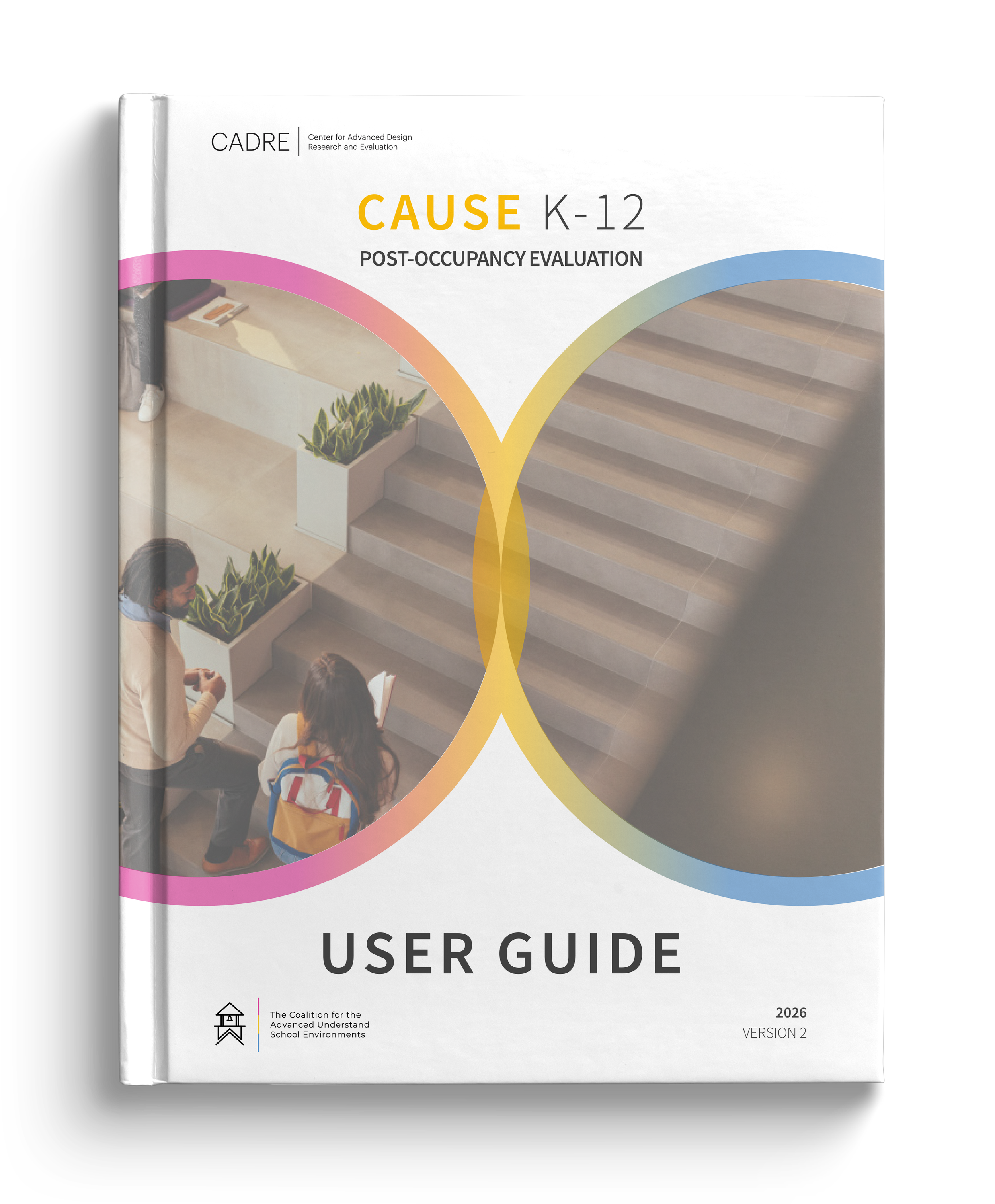
Now available: CAUSE User Guide 2.0
This updated resource provides clear, practical guidance for understanding and using the CAUSE Post-Occupancy Evaluation (POE) tools, helping districts, designers, and researchers evaluate and improve K–12 learning environments through evidence-based insights.
What is CAUSE?
The Coalition for the Advanced Understanding of School Environments (CAUSE) is a group of researchers who recognize the need for standardized Post-Occupancy Evaluation (POE) tools tailored specifically to K–12 schools.
Founded in 2023 and currently operating under the Center for Advanced Design Research and Evaluation (CADRE), CAUSE exists to help districts, designers, and researchers understand how school environments influence teaching, learning, and well-being.
Our call to action
Schools need standardized, open-source evaluation tools that capture information about K–12 environments and student and teacher experiences.
Such tools help foster innovative school design, improve educational outcomes, and reduce harmful environmental conditions.
CAUSE invites districts, designers, and researchers to adopt this shared framework so we can build a stronger evidence base together: one that improves school environments and supports student success.
2024 – 2027
Our timeline
-
Jan – Jun 2024
- Initial research foundations and literature review
- Research design and POE framework development
- Development of the Human-Building Interaction and Human Outcomes instruments
-
Jul 2024 – Jun 2025
- Alpha and beta testing of the Human-Building Interaction and Human Outcomes instruments
-
Jul 2025 – Jun 2026
- Public release of User Guide 1.0
- CAUSE Summit 1.0
- Development of the Spatial Characteristics and Building Performance instruments
-
Jul 2026 – Jun 2027
- CAUSE Summit 2.0
- Public release of User Guide 2.0 and the Whole Tool spreadsheet
- Full pilot testing of all instruments, with user feedback
-
Jul – Dec 2027
- Full tool evaluation
- Summary research report on the pilot study
- CAUSE Summit 3.0
Recent publications
- The Tension of Transparency in Schools
- What Gets Measured Gets Better, Part 4
- What Gets Measured Gets Better, Part 3
- January 2026Beyond Quiet and Calm: Designing (and Measuring) Spaces Students Can Use to Regulate LearningEssentials
- November 2025Building Places People Believe In: How Data Can Rebuild TrustCADRE
- October 2025The Science of Student Engagement: Measuring the Role of DesignEssentials
- Fall 2025What Gets Measured Gets Better, Part 2Learning By Design
- July 2025What Are We Doing Here? Evaluating Student Belonging in School EnvironmentsEssentials
- Summer 2025What Gets Measured Gets Better, Part 1 (references)Learning By Design
- February 2025Is the Policy Landscape Making It Harder for K–12 Designers to Perform Post-Occupancy Evaluations?CADRE
- Fall 2024K–12 POEs Are Inconsistent, Even at the Highest LevelLearning By Design
- October 2024CAUSE: 2 Cities, 2 Conferences, 1 DayCADRE
- October 2024Functional Design, Measured Learning: Linking Space to Educational Outcomes Through EvaluationEssentials
- April 2024Join the CAUSE: We Can Measure Impact Better TogetherEssentials
The people and partners behind CAUSE
Coalition founders


School district collaborators

Sponsors
Founding members
- KI
- Interface
- Rockfon
Industry partners
- Artcobell
- Smith System
- Tarkett
- VS America
CAUSE supporters
- In2 Architecture
Organizational partners
- 21st Century School Fund
- Association for Learning Environments
- BranchPattern
- Center for Green Schools
- Children’s Environmental Health Network
- EDmarket
- Learning By Design
- National School Plant Management Association
CAUSE team
Research co-leads
 Renae MantoothPhD, HKS
 Michael RalphPhD
 Erika EitlandScD, Perkins&Will
 Raechel FrenchPhD, Austin ISD
Project support
 Holly JohnsonCADRE
 Jordan DonopCADRE
 Jacob WilliamsPerkins&Will
 Kathleen O'DonnellCantilever Communications & Strategy, LLC
Past team members
Heliya Ahmadi (CAUSE Fellow), Mahya Fani (Project Support), Brad Hughes (NOMA Fellow), Alex Rett (CAUSE Fellow), and Aletta Vanderwalt (CADRE).
Advisory committees
School Design
Jacqui Bolenbough (Artcobell), Patricia Cadigan (Artcobell), Laura Casai (Kingscott Associates), Robert Dillon, PhD (Intentional School Designs), Linda Dove (Meteor Education), Maya Fraser (Quinn Evans), Leonardo Gonzalez Sangri (HKS), Catherine Hefler (Architecture49, Inc.), Celeste Karier (FGM Architects), Shivani Langer (Perkins&Will), Emily McGinnis (KI), Scot Morris (Smith System), Irene Nigaglioni (In2 Architecture), Sean O’Donnell (Perkins Eastman), Cleveland Reeves (BVH), Stacy Roth (DLR Group), and Jessie Sticklor-Lipson (Fielding International).
Design Research
Emily Chmielewski (Perkins Eastman), Mackenzie Cox (Multistudio), Amanda Gale (UNC Greensboro), Marcel Harmon (BranchPattern), Juan Matta (KI), Upali Nanda, PhD (HKS), Alina Osnaga (EDRA), Kimari Phillips (LPA), Traci Rider, PhD (NC State University), Brad Rogers (Perkins&Will), Dustin Saalman, PhD (NAC Architecture), Marisa Sergnese (Steelcase), Lennie Scott-Webber, PhD (INSYNC), and Helia Taheri, PhD (Arcadis).
Education Policy
Jill Ackers (VS America), James Basham (University of Kansas), Edna Butts (Austin ISD), Page Dettmann (Meteor Education), Mary Filardo (21st Century School Fund), Katelyn Forcucci (PD by Mien), Kyle Gorrell (LSR7 School District), Anisa Heming (Center for Green Schools), Brad Kiehl (HTK Architects), Danelle Marsden (Scott Rice Office Works), Lorraine Maxwell (Cornell University), Lizzie Scott (Artcobell), Ken Wertz (NSPMA), Nse Witherspoon (CEHN), and Xuemei Zhu (Texas A&M University).